

Inside Agwa News Osun State Governorship Election Results Overview
E-ISSN: 2354-4481
By Odunze Calista Chizaram
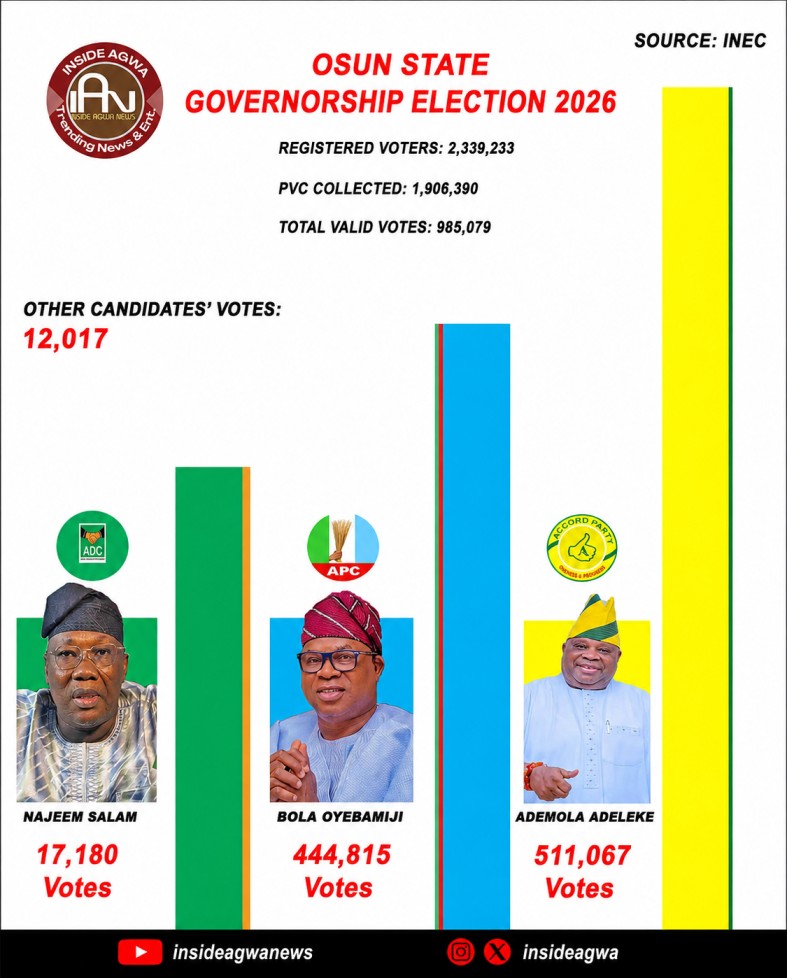
OSOGBO, OSUN STATE — The 2026 Osun State Governorship Election has produced a closely contested race, with Ademola Adeleke of the Accord Party emerging as the leading candidate with 511,067 votes and wining 19 out of 30 LGAs.
Bola Oyebamiji of the All Progressives Congress (APC) followed with 444,815 votes in 11 LGAs, leaving a margin of 66,252 votes between the two leading candidates.
Najeem Salam of the African Democratic Congress (ADC) recorded 17,180 votes, including lossing his LGA, while other candidates collectively secured 12,017 votes.
The results overview shows that a total of 985,079 valid votes were recorded from 2,339,233 registered voters. Of the registered voters, 1,906,390 collected their Permanent Voter Cards (PVCs).
Adeleke's victory places him ahead of the APC candidate after a competitive election in which the two leading parties accounted for the overwhelming majority of the votes cast.
The results indicate strong electoral support for both Adeleke and Oyebamiji, while the performance of the ADC and other participating parties was significantly lower. Adeleke's 511,067 votes gave him a 66,252-vote advantage over Oyebamiji.
The margin reflects the importance of voter mobilisation and grassroots political structures in determining the outcome of the election. Adeleke's ability to secure votes across key areas of the state proved decisive in putting him ahead of his closest challenger.
The APC's performance, however, demonstrates that the party remains a major political force in Osun State. With 444,815 votes, Oyebamiji finished strongly and maintained a substantial level of support across the state.
The result also highlights the limited impact of the smaller parties in the governorship contest. Although the ADC and other candidates participated in the election, their combined votes were far below the figures recorded by the two leading candidates.
Another major feature of the election was voter participation. The number of valid votes recorded was considerably lower than the number of registered voters and also below the number of PVCs collected.
The figures suggest that there remains significant room for increased voter participation in future elections. Greater civic engagement and voter mobilisation could have an important impact on the state's electoral process.
With the election concluded, attention will now shift to governance and the expectations of residents. The incoming administration will face demands to address economic development, infrastructure, employment, education, healthcare and other social services.
The administration will also be expected to build on existing policies and programmes while responding to emerging challenges confronting residents across the state.
Meanwhile, the opposition is expected to continue scrutinising government policies and programmes, particularly on issues of accountability, public spending and service delivery.
The 2026 election therefore marks another important development in Osun State's democratic history. While Adeleke emerged with a clear majority, the strong showing by the APC confirms that the state's political landscape remains highly competitive.
The 66,252-vote margin ultimately separated the two leading candidates, making voter mobilisation, grassroots organisation and electoral participation central factors in the outcome.