
THERE IS ALWAYS A REMNANT: WE HAVE ONE IN IMO NORTH — WHY OBOWO SHOULD NOT LET OBIOMA GO
E-ISSN: 2354-4481
By John Mbonu Uchenwoke-Ekperechi
“What is the spirit of Dr. Sam Mbakwe of blessed memory? He lived for his people. He overcame his mortal greed and used the resources of the people to improve their lives, leaving them better than he met them. That is the spirit of a leader driven by humanity, not materialism.”
In the political history of Imo State, few names command the emotional resonance of Dr. Samuel Onunaka Mbakwe, the celebrated former Governor of the old Imo State. Fondly remembered as the “Weeping Governor,” Mbakwe represented a tradition of public leadership in which political office was understood principally as an opportunity to serve, build and improve the material conditions of the people.
Whether in oral history, political literature or the institutional memory of the people, Mbakwe's legacy remains an enduring reference point for public service in the old Eastern Nigeria.
And today, another political figure from Obowo appears to be drawing inspiration from that tradition.
His name is Hon. Chief Obioma Ehirim, Esq., Executive Chairman of Obowo Local Government Area.
The question therefore deserves to be asked: Has the spirit of Mbakwe found another home in Obowo?
The answer may ultimately belong to history and the people of Obowo. But one thing is increasingly difficult to ignore: the project record presented by the Obioma administration reflects an approach to local government that places visible intervention, rural infrastructure and human development at the centre of governance.
This is particularly significant in an era when local government administration in Nigeria is frequently criticised for weak service delivery, poor infrastructure and the disconnect between public resources and the everyday needs of citizens.
A DIFFERENT POLITICAL ECONOMY OF LOCAL GOVERNANCE
The political economy of local government is not merely about budgets and allocations. It is about what public resources become after they leave government accounts.
Do they become roads that connect farmers to markets?
Do they become electricity that enables businesses to operate?
Do they become water that saves households the daily burden of searching for potable water?
Do they become classrooms, employment opportunities, healthcare access and functioning public institutions?
Or do they disappear into the familiar black hole of political consumption?
The reported interventions of the Obioma administration suggest a different philosophy.
Across Obowo's electoral wards — Amuzi, Umuariam/Achara, Avutu, Okenalogho, Odenkumme/Umuosochie, Umungwa/Amanze, Alike, Ehume and Okwuohia — rural road grading has been undertaken or supported.
For an agrarian society, rural roads are not cosmetic infrastructure. They are economic infrastructure.
A graded rural road can reduce transportation costs, improve access to markets, facilitate movement of agricultural produce, connect communities to schools and healthcare facilities, and make commercial activity less difficult.
That is why road maintenance scheduled across the LGA deserves attention. A road that remains passable is an economic asset.
ELECTRICITY AS AN ECONOMIC POLICY
Perhaps even more consequential are the reported rural electrification interventions.
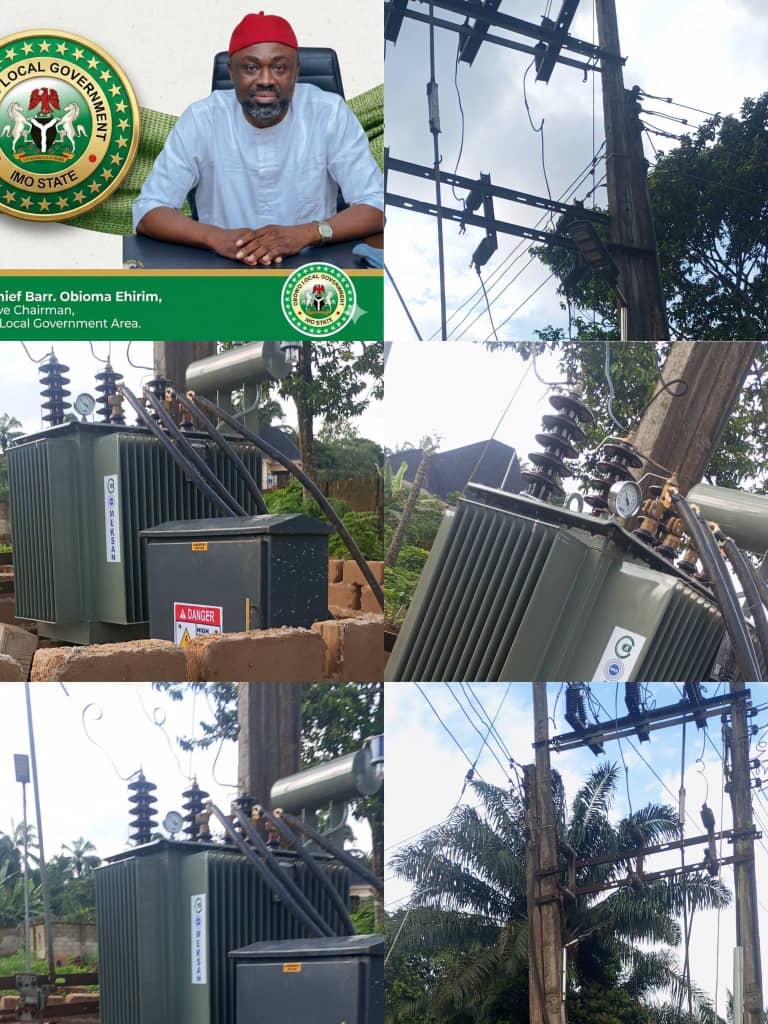
The administration has reported the purchase and energisation of a new 300KVA transformer and rehabilitation of the substation serving Umulogho, Umunze, Umunnem and parts of Umuokpa, following years of blackout.
At Imo Rescue Market, popularly known as Malaysia Market, Umungwa, another dedicated transformer, substation, poles, wires and associated electrical infrastructure have reportedly been installed.
Similar interventions are reported for Umuezeagu in Ehume Autonomous Community and Umuosochie Autonomous Community.
The administration also reports ongoing installation and energisation of new 500KVA transformers serving Umualaoma–Okwunezigwe in Amuzi Ward and Ogbuzuzu and Okpuala Mgbakam in Okwuohia Ward.
At Umukpa-Uhu, Amato, Alike Autonomous Community, a rural electrification project involving more than 21 electrical poles, copper cables and other components has reportedly been completed, while another intervention is ongoing around Umuohia na Umu'turu, Umuada–Avutu Autonomous Community.
These projects matter beyond electricity itself.
Electricity means longer business hours for traders. It means improved conditions for artisans, welders, barbers, mechanics, cold-room operators, food processors and small manufacturers. It can reduce dependence on expensive generators and create conditions for young people to develop businesses locally rather than immediately seeking opportunities elsewhere.
In economic language, electrification can increase productive capacity.
In the language of an ordinary Obowo household, it simply means life becomes easier.
WATER: FROM NEGLECT TO PUBLIC ASSET
The reported rehabilitation of abandoned water infrastructure may be equally important.
The administration has undertaken reconstruction and conversion of moribund generator-powered boreholes into solar-powered water facilities in Amuzi, Okwuohia, Umunachi, Odenkumme, Umuariam, Orie Alike Market and Ehume, with periods of previous dereliction reportedly ranging from approximately 18 to 20 years.
An additional rehabilitation of the Otoko water borehole is reported.
This is not merely a water project.
It is a public-health intervention, a household-economy intervention and a time-saving intervention.
Where water is unavailable, families spend money and time obtaining it. Where functioning public water exists, that burden can be reduced.
The conversion to solar power is also economically significant because it potentially reduces dependence on fuel for operating water facilities.
RESTORING THE DIGNITY OF GOVERNMENT
There is another dimension of the Obioma record that deserves attention: the rehabilitation of the Otoko Council Complex.
The reported interventions include restoration of electricity, revival of a standby soundproof generator, ongoing solar installation, rehabilitation of the Council Hall, provision of conference furniture, renovation of the Legislative Council Hall and offices, renovation of executive and administrative offices, restoration of internal road paths, solar-powered streetlights and other environmental improvements.
The abandoned office building project is also reportedly being recommenced, while fencing of the Otoko Police Station has been proposed.
Why should this matter?
Because a government that cannot maintain its own administrative environment sends a message about institutional decline.
Functional council facilities improve the environment in which public servants, councillors and administrators conduct government business. In turn, better administrative capacity can improve service delivery.
EDUCATION, EMPLOYMENT AND HUMAN CAPITAL
Perhaps one of the most strategically important interventions is the reported establishment of the National Teachers Institute Study Centre in Obowo.
According to the project record, free application forms were provided for 120 sons and daughters of Obowo, while 18 qualified indigenes reportedly gained employment as educational staff.
This goes beyond a physical project.
It is an investment in human capital.
A young person who can acquire a degree or professional qualification without leaving the community has gained an opportunity that may affect an entire household for years.
Education creates income opportunities, improves professional capacity and potentially strengthens the local economy.
That is why governance should not be measured only by concrete and roads. The greatest infrastructure is sometimes the human being who receives an opportunity to improve his or her life.
HEALTH, ECONOMIC ACTIVITY AND POLITICAL REPRESENTATION
The reported enrolment of 2,000 Obowo residents into the Governor Uzodimma Health Insurance Scheme represents another social intervention.
Healthcare costs can place severe pressure on household finances. Health insurance, where effectively implemented, can reduce that burden and improve access to healthcare.
The phased rehabilitation and upgrading of the Ikeja Abattoir at Ehume also has economic implications for meat traders, butchers, livestock-related businesses, consumers and public health.
There is equally the reported ₦60 million disbursement to the Obowo Legislative Council in lieu of constituency projects, with each councillor receiving ₦6 million for constituency interventions, alongside ₦10 million to the Office of the LGA Vice Chairman for constituency projects.
These interventions, if transparently implemented and properly accounted for, can decentralise development and allow elected representatives to respond to community-specific needs.
BEYOND THE ERA OF “SITTING ON THE BUDGET”
For many Nigerians, the historical image of local government leadership has sometimes been associated with the enormous political and economic power once concentrated around council chairmen and the local government budget.
That era created enormous expectations — and, inevitably, enormous questions about accountability.
But leadership should not be measured by how much power an officeholder controls.
It should be measured by what remains after the officeholder leaves.
A transformer remains.
A functioning borehole remains.
A road remains.
A school opportunity remains.
A trained teacher remains.
A functioning council facility remains.
An empowered trader remains.
A healthier population remains.
That is the essence of political legacy.
And this is where Obioma's reported interventions become politically significant.
The argument is not that every project has been completed or that every challenge in Obowo has disappeared. Far from it. Obowo still has development needs, and every public project must remain subject to transparency, verification, maintenance and accountability.
But if the stated projects are implemented as reported, they represent an attempt to convert local government resources into tangible social and economic assets.
That is a political philosophy worth examining.
SHOULD OBOWO LET OBIOMA GO?
The title of this editorial asks why Obowo should not let Obioma go.
That question is ultimately for the people of Obowo and the political process to answer.
But history teaches one important lesson: political offices come and go, while legacies remain.
If a chairman uses the opportunity available to him to build roads, restore electricity, revive water systems, improve public institutions, create educational opportunities, support healthcare access and stimulate local economic activity, then his tenure deserves to be judged by the value those interventions create for ordinary people. And if he has another tenure to do, he should be supported to do so if he shows interest. To be explicit, Hon. Chief Obioma Ehirin, deserved to continue his good works!
Perhaps that is why the comparison with Mbakwe has emerged.
Not because any living political officeholder should be casually declared greater than a historic figure whose legacy belongs to an entire generation, but because Mbakwe represents a standard of public service against which subsequent leaders are naturally measured.
Could Obioma become another enduring name from Obowo's political history?
Only time will tell.
But if there is indeed a “remnant” of the Mbakwe tradition in contemporary Imo politics, then Obowo has a responsibility to preserve the values of service, accountability, development and humanity that made that tradition powerful in the first place.
Nigeria does not necessarily suffer from a shortage of politicians.
Nigeria suffers from a shortage of political leadership that can convert public resources into public value.
The difference is profound.
Greed consumes resources.
Good governance converts resources into opportunities.
Materialism asks, “What can I take from office?”
Legacy asks, “What will remain after I leave?”
And perhaps that is the real question for Obowo, Imo North and the wider political class:
When the power is gone, the convoy is gone, the title is gone and the budget is gone — what will the people remember?
For Obioma Ehirim, the answer may ultimately be found not in political speeches, but in the roads graded, the transformers energised, the boreholes revived, the students educated, the workers employed, the patients enrolled, the markets illuminated and the institutions restored.
As the great African statesman Nelson Mandela famously reminded the world:
“What counts in life is not the mere fact that we have lived. It is what difference we have made to the lives of others.”
And in the enduring spirit of public service:
“Public office is a trust; its greatest reward is not what the officeholder acquires, but the good that remains with the people after the officeholder has gone.”
By John Mbonu Uchenwoke-Ekperechi
Publisher and Chief-Editor-in-Chief, Inside Agwa News (IAN)
Columnist, “Shadow of the Flag”
History and International Studies, University of Nigeria, Nsukka, Campus
Writes from Owerri, Imo State.