
Women Affairs Minister, LGCF Move to Strengthen Child Protection in Nigeria
ISSN: 2354-4481
By George Gentle Ifeanyi
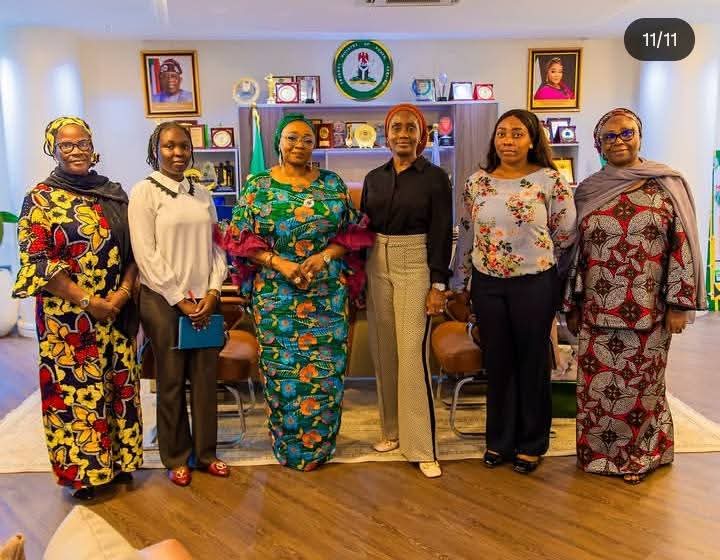
ABUJA — The Honourable Minister of Women Affairs and Social Development, Imaan Sulaiman-Ibrahim, FSI, has received the Executive Director of Legend Golden Care Foundation (LGCF), Mrs. Kanayo Olisa-Metuh, on a courtesy visit focused on strengthening collaboration on child protection and welfare in Nigeria.
The meeting centred on the need to improve the protection, rehabilitation and reintegration of children, particularly those who come into conflict with the law.
The discussions emphasised the importance of ensuring that children who have committed offences or found themselves in difficult circumstances are not permanently defined by their mistakes. Participants stressed that such children require appropriate legal protection, rehabilitation, psychosocial support, education and opportunities to return safely to their families and communities.
The engagement also highlighted the need for stronger cooperation among government institutions, civil society organisations and other child-focused stakeholders to build a child protection system capable of responding effectively to abuse, exploitation, violence and other threats to children's wellbeing.
The meeting comes against the backdrop of continuing concerns over the protection of children in Nigeria. The country's Child Rights Act, 2003, provides the principal federal legal framework for protecting children's rights and was enacted to domesticate key provisions of the United Nations Convention on the Rights of the Child.
Nigeria has also recorded progress in strengthening its child protection and justice systems. According to UNICEF's 2025 annual report, more than 1,000 children, including over 200 girls, were released from detention through diversion and non-custodial measures in 2025, with aftercare and reintegration support provided to many of them. The report also said nearly 120,000 children accessed child protection services during the year, including mental health and psychosocial support, counselling and reintegration services.
At community level, UNICEF said Nigeria strengthened almost 2,000 community-based child protection structures across 17 states and the Federal Capital Territory in 2025. Nearly 1,000 police officers were also trained in child-sensitive investigation techniques and procedures for handling cases involving children.
The legal landscape has also expanded. UNICEF reported in 2022 that 31 states had domesticated the Child Rights Act, with Adamawa, Bauchi, Gombe, Kano and Zamfara yet to do so at that time.
More recent sources indicate that the legal position has since advanced, with the European Union Agency for Asylum reporting in January 2026 that all 36 states had domesticated the Act, although implementation remained uneven across the country. Partners West Africa Nigeria has similarly reported that all 36 states and the Federal Capital Territory have now domesticated child-rights legislation, while stressing that enforcement and institutional capacity vary considerably.
However, legal domestication has not automatically translated into uniform protection for every Nigerian child. UNICEF's State of Nigeria's Children 2024 noted that Nigeria has nearly 105 million children and adolescents aged 0–17, representing about half of the country's population, while poverty, inadequate access to quality education, poor nutrition and violence continue to threaten children's development and wellbeing.
Nigeria's international ranking also underscores the scale of the challenge. The KidsRights Index 2026, published by the KidsRights Foundation, ranks Nigeria 191st overall among the countries assessed.
Nigeria recorded an overall score of 0.304, with a protection-domain score of 0.385. The index evaluates children's rights across areas including life, health, education, protection and the enabling environment.
For comparison, Nigeria ranked 181st out of 194 countries in the 2025 KidsRights Index, with an overall score of 0.364.
The ranking should not be interpreted as a direct measure of the Child Rights Act itself, but rather as a broader assessment of the country's performance on children's rights and related conditions.
The collaboration between the Ministry of Women Affairs and Social Development and LGCF therefore reflects the growing need to move beyond legislation to effective implementation, adequate funding, specialised services and child-sensitive justice.
For children in conflict with the law, stakeholders say rehabilitation and reintegration should remain central to the response. Providing education, counselling, family support and opportunities for a productive future can help prevent repeat offending while protecting children from further abuse and marginalisation.
The Minister's engagement with LGCF is expected to contribute to wider efforts to ensure that every Nigerian child enjoys protection, dignity, access to justice and a genuine opportunity to rebuild and fulfil their potential.